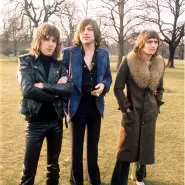
“Jerusalem” is a poem written by William Blake in 1804. The music was composed by Hubert Parry about a century later. It quickly became a sort of English anthem. ELP is not responsible for either the words or music.
I think the imagery of the first two lines (i.e. of feet upon mountains in ancient times) recalls another poem about Jerusalem from ancient times, one found in Isaiah 52:7:
“How beautiful upon the mountains are the feet of the messenger who announces peace, who brings good news…”
Christians interpreted this as a foretelling of Jesus who brought the good news ( = “Gospel”). I don’t think one should be so specific as to reference it to the Sermon on the Mount, or the Mount of Transfiguration, or Mount Zion, or Golgotha, though each might be valid.
Blake is also making an allusion to folklore that tells of Jesus traveling to England with his uncle, Joseph of Arimathea. I wouldn’t put much stock in the historicity of that account, and Blake didn’t really do more than question the assertions of that tale. Blake’s real interest is not in looking backwards and laying claim to England’s superior Christian ancestry. (Nor is he looking forward to some “Sweet By and By” salvation.) Blake’s focus is on the immediate condition of England. Do the dark satanic mills refer to the blight of the industrial revolution? The grind of the organized church? Something else? All of the above? I suspect the organized church but am not sure. In any event, Blake is calling for action here and now.
The bow and arrows and spear recall the “whole armor of God” in Ephesians 7:11-17. The Chariot of Fire (in 2 Kings 2:11) took Elijah to heaven in a whirlwind. I think Blake is saying we must not rest until we have transformed our society and built our heaven, our new Jerusalem, here on earth (in England).
Bingo. About time someone dug deeper and thought like BLAKE the Author and not like Keith Emerson. I love the song but I think some people see what is in their own minds eye rather than the original intent of the poem. Thanks
Bingo. About time someone dug deeper and thought like BLAKE the Author and not like Keith Emerson. I love the song but I think some people see what is in their own minds eye rather than the original intent of the poem. Thanks
@evander I hear ya! We often think of Jerusalem in Israel. But the people of England embraced this poem and made it as an anthem for England. I think it wonderful. It makes me wish I lived in England, as I originally live in America.
@evander I hear ya! We often think of Jerusalem in Israel. But the people of England embraced this poem and made it as an anthem for England. I think it wonderful. It makes me wish I lived in England, as I originally live in America.


“Jerusalem” is a poem written by William Blake in 1804. The music was composed by Hubert Parry about a century later. It quickly became a sort of English anthem. ELP is not responsible for either the words or music.
I think the imagery of the first two lines (i.e. of feet upon mountains in ancient times) recalls another poem about Jerusalem from ancient times, one found in Isaiah 52:7:
“How beautiful upon the mountains are the feet of the messenger who announces peace, who brings good news…”
Christians interpreted this as a foretelling of Jesus who brought the good news ( = “Gospel”). I don’t think one should be so specific as to reference it to the Sermon on the Mount, or the Mount of Transfiguration, or Mount Zion, or Golgotha, though each might be valid.
Blake is also making an allusion to folklore that tells of Jesus traveling to England with his uncle, Joseph of Arimathea. I wouldn’t put much stock in the historicity of that account, and Blake didn’t really do more than question the assertions of that tale. Blake’s real interest is not in looking backwards and laying claim to England’s superior Christian ancestry. (Nor is he looking forward to some “Sweet By and By” salvation.) Blake’s focus is on the immediate condition of England. Do the dark satanic mills refer to the blight of the industrial revolution? The grind of the organized church? Something else? All of the above? I suspect the organized church but am not sure. In any event, Blake is calling for action here and now.
The bow and arrows and spear recall the “whole armor of God” in Ephesians 7:11-17. The Chariot of Fire (in 2 Kings 2:11) took Elijah to heaven in a whirlwind. I think Blake is saying we must not rest until we have transformed our society and built our heaven, our new Jerusalem, here on earth (in England).
Bingo. About time someone dug deeper and thought like BLAKE the Author and not like Keith Emerson. I love the song but I think some people see what is in their own minds eye rather than the original intent of the poem. Thanks
Bingo. About time someone dug deeper and thought like BLAKE the Author and not like Keith Emerson. I love the song but I think some people see what is in their own minds eye rather than the original intent of the poem. Thanks
@evander I hear ya! We often think of Jerusalem in Israel. But the people of England embraced this poem and made it as an anthem for England. I think it wonderful. It makes me wish I lived in England, as I originally live in America.
@evander I hear ya! We often think of Jerusalem in Israel. But the people of England embraced this poem and made it as an anthem for England. I think it wonderful. It makes me wish I lived in England, as I originally live in America.
@evander, not necessarily to you but to the ones casting the downvotes...why??
@evander, not necessarily to you but to the ones casting the downvotes...why??